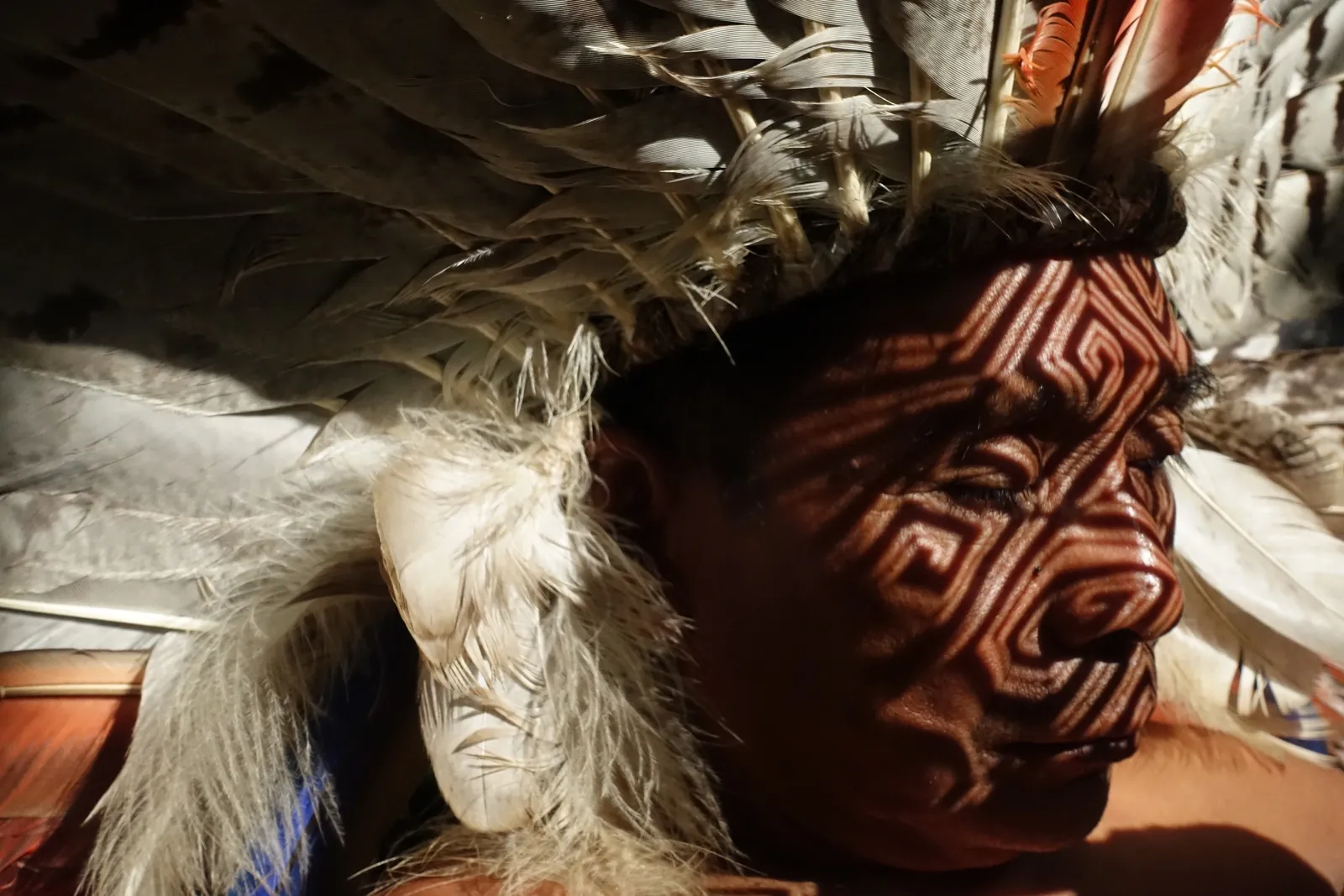
Same Putumi
In 2018 Same Putumi and I were introduced through friends in São Paulo, at an event where she was a guest speaker. Shortly afterwards I went to her region on the upper Envira river to exchange knowledge and design projects together. The residency lasted a month, and the partnership outlasted it.
What brought us together was a love of patterns.
Same Putumi is part of the Huni Kuin, a Brazilian and Peruvian indigenous group living in the Amazonian forest. She is an artist, an artisan, a healer and a religious leader, a mother of six, and she often travels to São Paulo to perform at cultural events.
Geometric design is sacred to the Huni Kuin and inseparable from daily life. They paint their faces with patterns continually, and use them on their objects, their clothes and anything else that will take them. In ritual, under ayahuasca, they see patterns everywhere.
I had come to patterns from history. Portuguese tiles first, then their debt to Islamic art, then the relationship with Chinese ornament, and from there an interest in how patterns travel the world. We met somewhere in the middle.
Both of us have looked for ways to put traditional technique together with new technology. Same has collaborated with electronic musicians, singing in her ancestral language over a live set. I turn patterns into animations, or cut them into stencils for painting. In the villages we used those stencils for body painting with traditional pigments, and for photographic and projection experiments. In February 2019 we produced an installation for the Museum of Image and Sound in São Paulo, with the artist Verônica Natividade.
Each one led somewhere else
Six pieces of work came out of the partnership. Each has its own page.
- 01
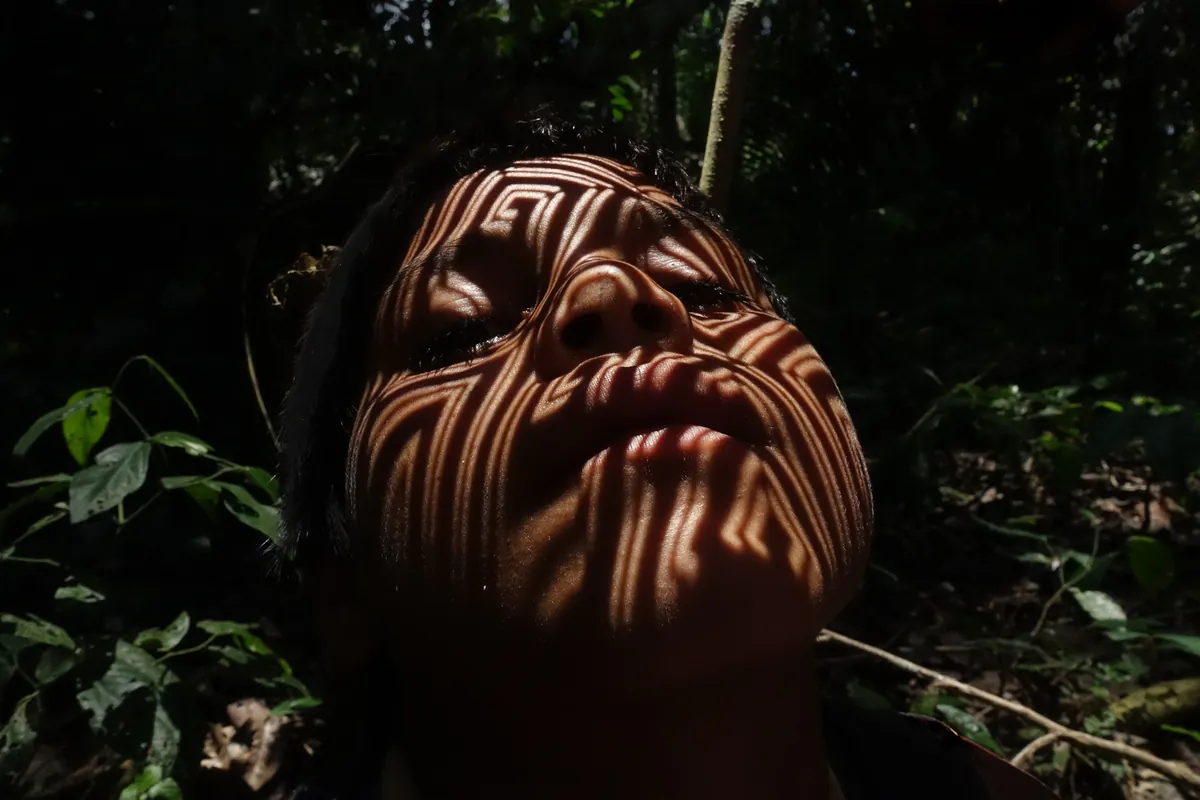 The first immersion September 2018 · Upper Envira river, Acre A month living among the Huni Kuin of the upper Envira, invited by Same Putumi, to understand the region first and design anything only after that.
 - 02
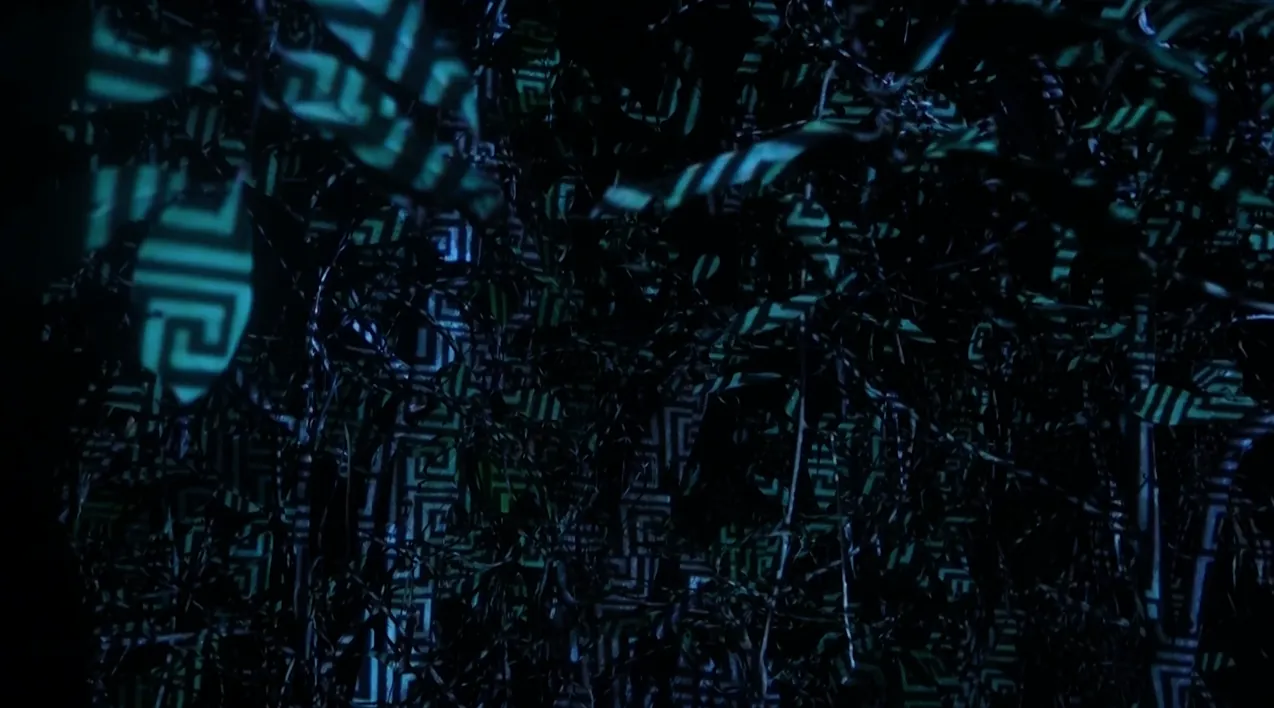 Katxanawa, video mapping 2019 · Upper Envira river, Acre Katxanawa is a traditional Huni Kuin song asking for abundance and luck. We built a projection around Same singing it.
 - 03
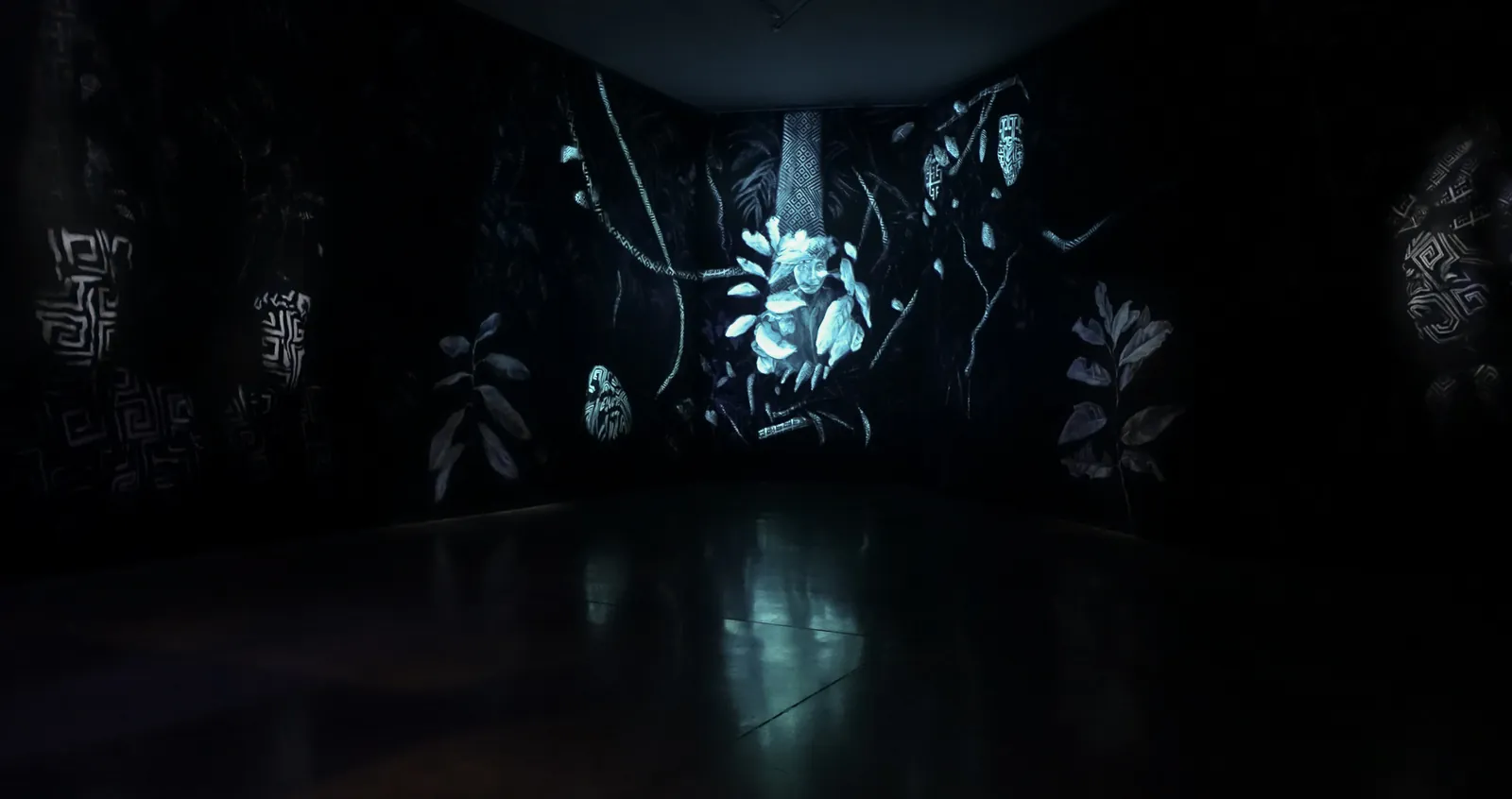 Nhandepa, the exhibition 14 February to 10 March 2019 · Museum of Image and Sound, São Paulo Nhandepa combines Nhanderu, a Guarani divinity, with Epa Kuxipa, a Huni Kuin one. The name is an argument: that different indigenous groups need to recognise one another and work together.
 - 04
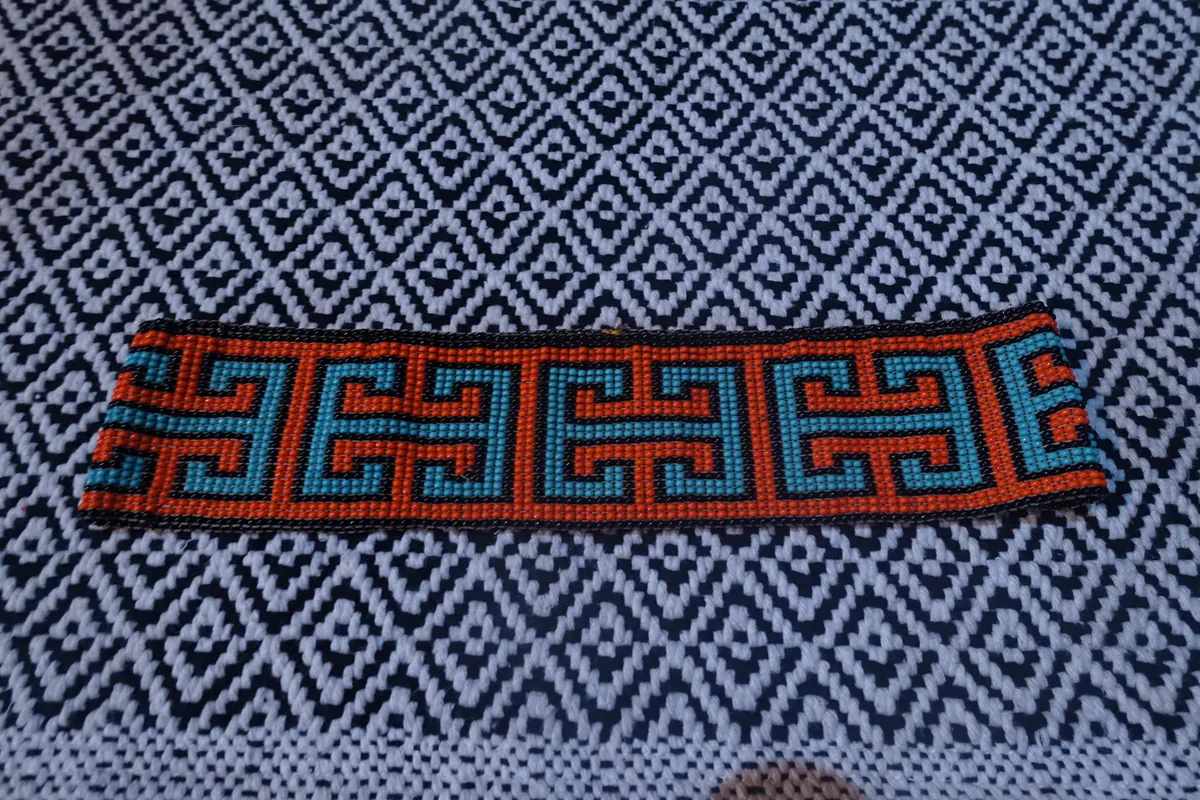 Research & education 2020 · São Paulo · FabLearn Global and FabLearn Asia Taking the pattern work into a classroom: indigenous design, algorithmic design and digital fabrication, for high-school students in São Paulo.
 - 05
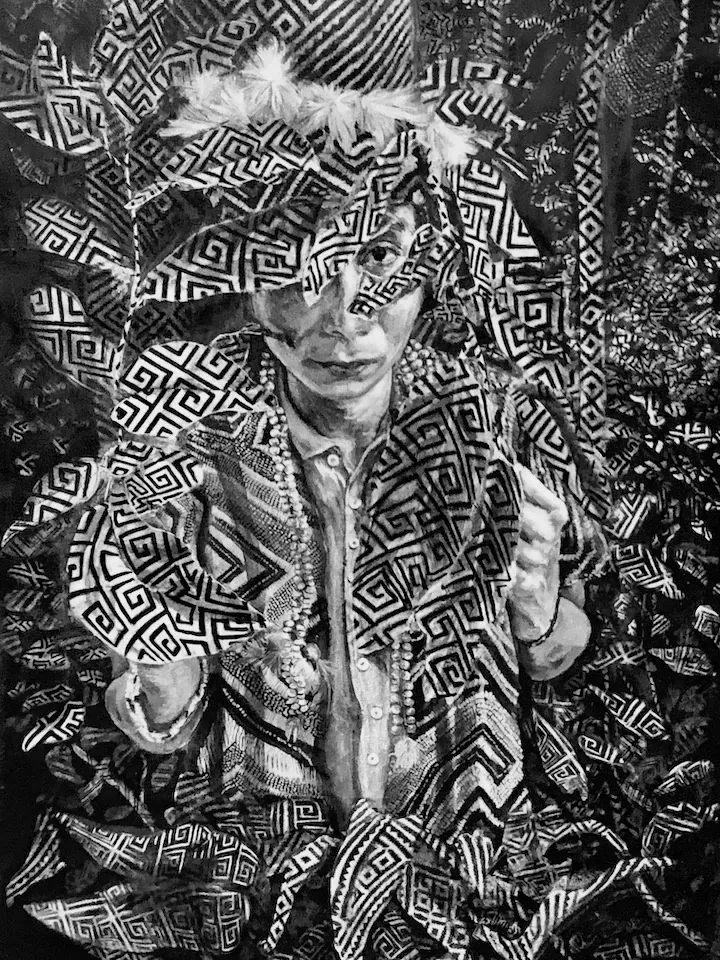 Prints 2019 · Artur Fidalgo Gallery, Rio de Janeiro High-quality prints based on the main painting from the Nhandepa installation, each with small changes added by hand.
 - 06
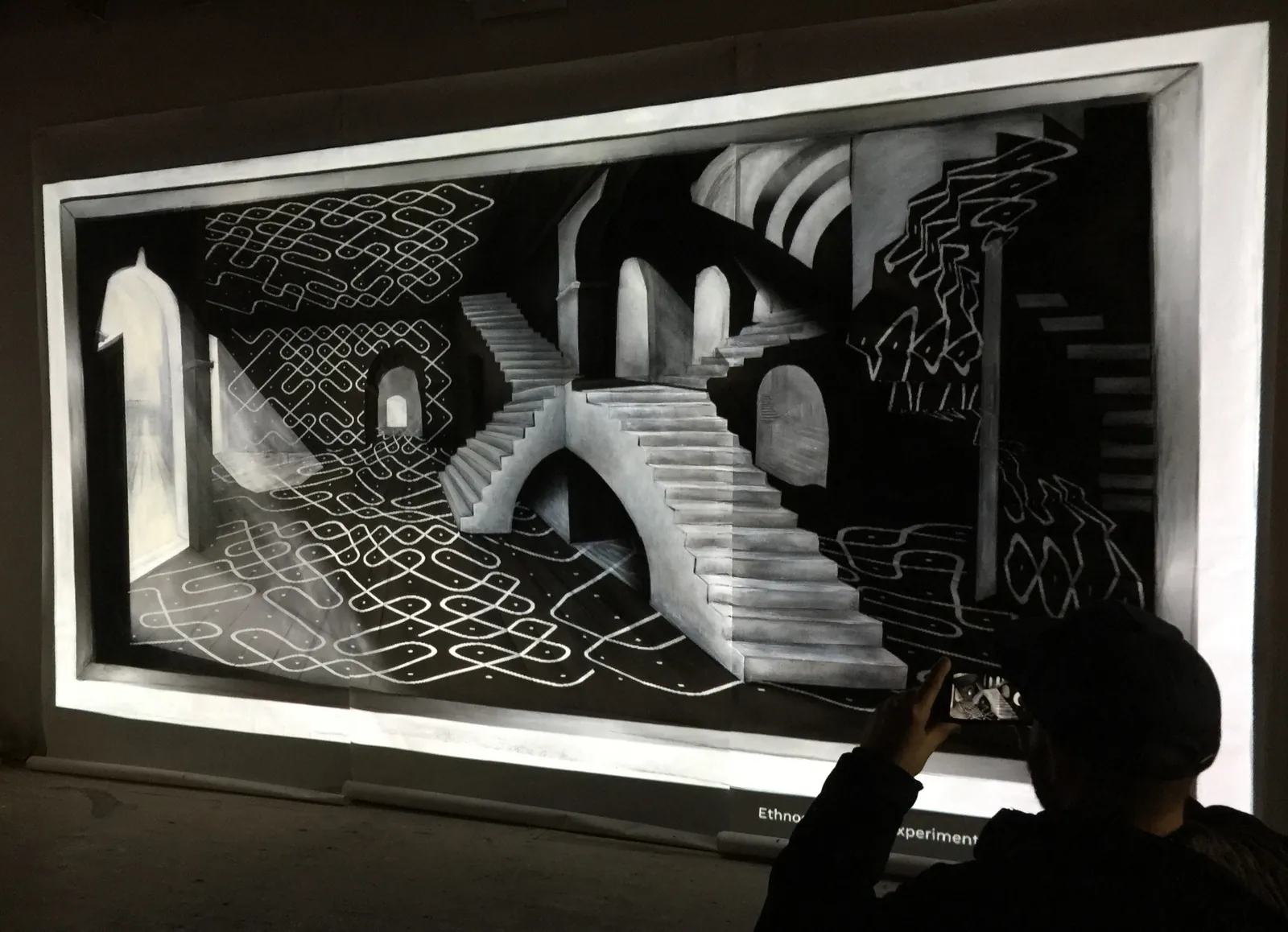 Ethnocomputing Experiments April 2018 · Pioneer Works, New York Two systems of representing the world, both mathematical in their treatment of line, projected onto one another. A related project, not co-authored with Same
Indigenous Amazonia and technology
An independent essay written after the first immersion · October 2018 · 14 pages
Independent research, written after the month on the Envira because it seemed important, not because any institution asked for it. What technological exchange with Amazonian indigenous communities could look like if it were led by the communities themselves, and what it becomes if it is not. It takes up the questions raised by MIT Media Lab’s Space Enabled group about democratising space technology for social justice.
- Acre stands out in the Brazilian Amazon for its indigenous rights record. Since the 1970s indigenous leaders and rubber tappers organised together as the “forest peoples”. Nearly half the state is protected forest; 15% is Indigenous Territory, home to around 18,000 people from the Pano, Aruak and Arawá language families.
- The Huni Kuin belong to the Pano family and are the most populous group in the state, roughly 8,000 people. Some villages are seven days by boat from the nearest town.
- Same asked for help developing a multimedia laboratory in her village, a compact field lab that could support her own research into medicinal plants, and legitimise Huni Kuin knowledge as relevant to the wider scientific community. There is still very little biological and medical research led by Brazilian indigenous groups; an American held a patent over an ayahuasca composition from 1981 before indigenous organisations discovered and contested it.
- In the Huni Kuin knowledge system, the study of medicinal plants is not separable from abstract drawing or from ritual. A laboratory would also have to be a place for artistic and spiritual practice.
- Ethnocomputing, the study of the interactions between computation and culture, is the theoretical frame. Ron Eglash and Nettrice Gaskins have shown a pedagogy built on the algorithmic properties of cultural patterns; for a people whose central cultural activity is abstract drawing, that is a way into programming that starts from what they already know.
- The alternative is worse than nothing: technological transfer without symbolic intermediation is simply a new version of cultural colonialism.
- 2020 Making across cultures, FabLearn Global and FabLearn Asia, educators’ panel
- 2019 Nhandepa, MIS São Paulo, with Same Putumi and Verônica Natividade, São Paulo
- 2019 Nhandepa, open debate, Museum of Image and Sound (MIS), 16 February 2019, São Paulo, Brazil
- 2018 Amazon residency with the Huni Kuin community, One month living and collaborating with Huni Kuin artists and elders, the Same Putumi project, Acre, Brazil
Gerdes, Paulus. The Circle and the Square.
Eglash, Ron. African Fractals: Modern Computing and Indigenous Design. Rutgers UP, 1999.
Gaskins, Nettrice. On techno-vernacular creativity and ethnocomputing.
01 Visible Memories02 Maurício Hora03 Silk Roads04 Ethnomathematics & Ethnocomputing05 Same Putumi06 Mars College07 Little Martians